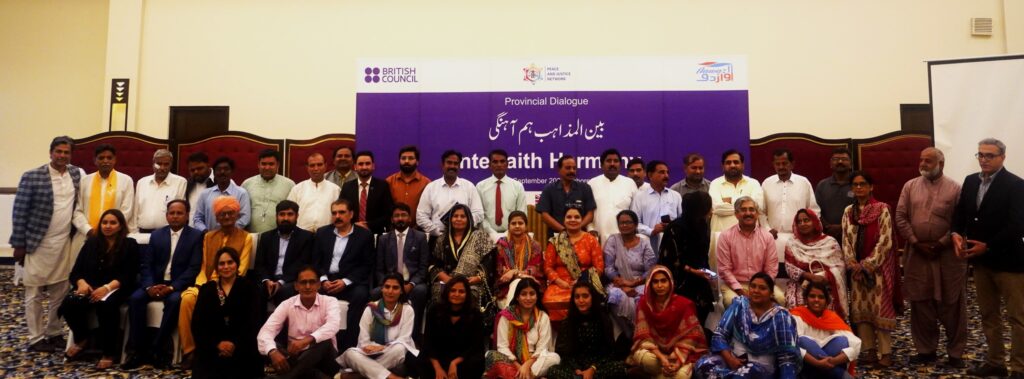
PJN , British Council Collaborate for Punjab’s Social Cohesion
Islamabad : The Peace & Justice Network (PJN), in conjunction with the British Council,
hosted a dialogue session called “Awaz Il” last day to discuss ways to
strengthen interfaith harmony and social cohesion among local communities in
Punjab.
According to details , Around 77 provincial-level stakeholders, including
representatives from the Department of Human Rights and Minority Affairs,
National Commission for Human Rights, Punjab Women Protection Authority,
Augaf and Religious Affairs Department, IT University Punjab, Social Welfare
& Balt-ul-Maal Department Punjab relevant institutions were participated on
this occasion.
The provincial dialogue aimed to create a platform to highlight the issue of
minorities and also to permote the tolerance in the society.
In her welcome remarks Dr Yasmin Zaidi, Team Lead British council, Aawaz I|
also said that “Part of Aawaz I| ” project to address discrimination, exclusion
and exploitation faced by vulnerable segment of the society.
She explained that the Aawaz ll project is currently active in 37 districts within
Punjab and Khyber Pakhtunkhwa.
The initiative’s objectives include establishing community forums,
implementing community-driven early warning systems and early response
mechanisms (EWS-ERM), promoting connections among individuals from
different faiths, and strengthening their relationships with relevant government
institutions.
On this occasion Dr Ahmed Afnan, Additional Secretary, Auqaf and Religious
Affairs Department
Punjab, has said that “there is dire need to improve interaction and undertake
awareness campaigns to promote tolerance and strengthen social cohesion in
the society”.
He went on to mention that the Pakistan Bait UI Mall is working to improve
social cohesion and elevate the status of religious minorities throughout
Punjab.
Participants representing religious minorities from different districts of Punjab
provided case examples of the best practices from Aawaz ll’s experiences in
various districts, sharing testimonies of case studies such as conflict over
burial places, in cidents of societal intolerance and dispute over water Source
which were successfully pre-empted with the help of EWS-ERM that Aawaz Il
established across its communities.
During the process, participants, especially members from religious minorities
shared several recommendations to promote interfaith harmony and
safeguard the rights of religious minorities.
These recommendations included organising capacity-building sessions for
district human rights and interfaith harmony committees, addressing behaviour
change in schools to prevent false blasphemy allegations against children,
offering alternatives to compulsory Quranic classes for children of religious
minorities.
Their suggestions emphasized the importance of inclusivity and the protection
of minority rights within the community.
Aawaz ll aims to create awareness, behaviour change and increase citizen-
state engagement to promote behaviour change on harmful practices of child
marriage, gender-based violence, exclusion, exploitation and intolerance.
The programme has reached over 30 million individuals with its interventions
including communications campaigns on behaviour change.
The five-year program is administered by the British Council with backing from
the Foreign, Commonwealth, and Development Office (FCDO). It has called
for a Provincial Dialogue to Promote Interfaith Harmony.
Arshad Mehmood, Deputy Team from British Council, and Syed Raza Ali,
CEO of PJN, urged the government to promptly establish a national
commission for minority rights.
The speakers emphasized the importance of interfaith harmony, stating that it
aims to create a platform for highlighting the issues faced by religious
minorities while promoting tolerance and understanding in society.
They highlighted that interfaith harmony plays a crucial role in creating a
platform to address minority concerns and promote tolerance within society.