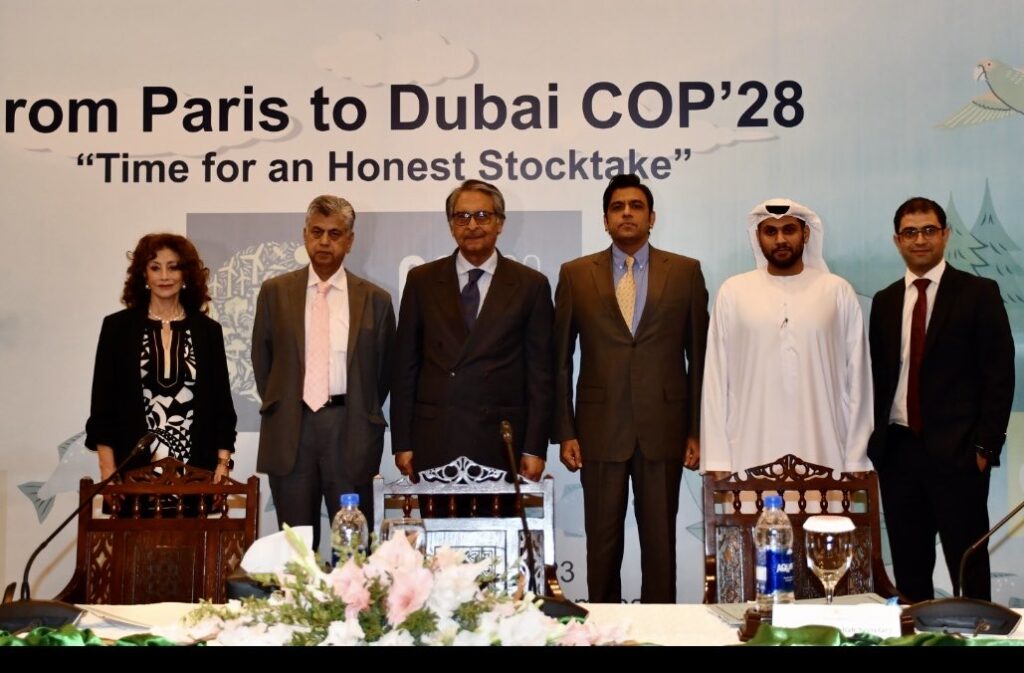
Islamabad : Rashid AbdelRehman Al Ali, Deputy Head of Mission at the UAE Embassy in Islamabad, expressed the COP28 Presidency’s commitment to delivering a comprehensive plan of action at this milestone event. He eagerly anticipated the collaboration between the UAE and Pakistan during the conference.
He said, “Aligned with its visionary leadership, the UAE’s Presidency of the COP28 conference will accelerate global efforts to address the consequences of climate change, particularly as the event will include the response to the first Global Stocktake for the implementation of the goals of the Paris Agreement, which represents a highly significant milestone in the world’s shared climate action.”
His Excellency added that COP28 Presidency aims for the conference to represent a turning point in achieving tangible and substantial progress in global climate action, in conjunction with achieving sustainable economic and social development, through its action plan based on four pillars: accelerating the achievement of an organized, responsible and just energy transition, developing climate finance mechanisms, safeguarding people and improving livelihoods, and supporting the previous pillars by hosting a fully inclusive conference.
He also underscored the importance of cooperation between the UAE and the Islamic Republic of Pakistan in the realm of climate action, particularly during the UAE’s hosting of COP28.
Foreign Minister Ambassador Jalil Abbas Jilani and Minister for Information and Broadcasting, Murtaza Solangi. Ambassador Jilani underscored Pakistan’s readiness to play a constructive role in Dubai and stressed the urgency of course correction to ensure a brighter future for our children. He emphasized Pakistan’s willingness to contribute to the solution, and he highlighted the pivotal role of the Global Stocktake in achieving global course correction, which is crucial for the success of COP28.
Minister Solangi emphasized the need to cultivate a culture of social responsibility regarding climate change, advocating for conversations to begin in various forms of media, including news, drama, film, and poetry. He announced the forthcoming introduction of a dedicated Climate Desk at PTV, designed to act as a catalyst for fostering a holistic, whole-of-society approach.
The Civil Society Coalition for Climate Change (CSCCC), with the support of the United States Institute of Peace (USIP) and the United Arab Emirates Embassy in Pakistan, hosted a pre-COP28 seminar titled, “From Paris to Dubai: Time for an Honest Stocktake.” This event served as a platform for government officials, experts, academics, civil society representatives, and the media to come together and strategize for Pakistan’s role in the upcoming Conference of Parties (COP), scheduled to commence next month in Dubai.
Aisha Khan, the Chief Executive of CSCCC, commenced the session with welcoming remarks, underscoring the organization’s continuous commitment to hosting pre-COP events since 2016. These events aim to broaden advocacy efforts, increase awareness about climate change, and facilitate interdisciplinary discussions that connect climate-related issues with various sectors. She stressed that climate security lies at the core of human security, necessitating an urgent refocusing on Peace, Prosperity, Partnerships, and the well-being of both people and the planet.
In parallel, Imran Khan, the Country Director of USIP, echoed the pressing need to integrate climate change into all policy and strategic discussions, recognizing its role as a potent threat multiplier.
Following the plenary session, a moderated panel discussion took place during the seminar, with Aisha Khan serving as the moderator. The panel featured a diverse group of experts, including Ambassador Sohail Mahmood, DG Institute of Strategic Studies, Islamabad (ISSI); Tanveer Paracha, DG National Institute of Disaster Management (NIDM); Dr. Zeba Sathar, Country Director, Population Council; and Imran Khan, Country Director, USIP. The discussion revolved around the intricate relationship between climate change and security, emphasizing the need for collective ownership and shared responsibility between all tier of government and society.
The seminar was brought to a close by Dr. Abid Suleri, the Executive Director of the Sustainable Development Policy Institute. During his concluding remarks, Dr. Suleri emphasized that a significant challenge in addressing climate change lies in the lack of integration and synchronization of governance and policy related to the climate agenda. He underscored the necessity of exploring alternative models for climate financing, drawing a parallel to how the World Food Programme was established as an entity separate from the FAO to tackle the challenge of food security. Dr. Suleri stressed that similar mechanisms are urgently needed for addressing climate-related issues.