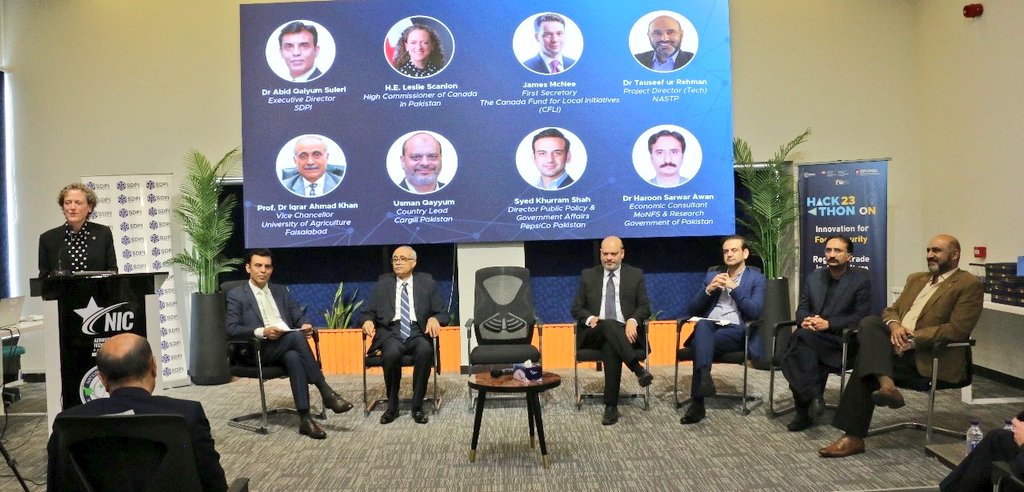
ISLAMABAD : The speakers at the Food Security Hackathon have called for innovation for food security and regional trade in agriculture through bridging ideas to action through the hackathon and funding partnerships. They highlighted the significance of collaboration, technology, and sustainable practices in ensuring food security in Pakistan. The Hackathon was organized by the Sustainable Development Policy Institute (SDPI) in collaboration with the Canadian High Commission, and National Incubation Centre for Aerospace Technologies.
Air Commodore Dr Tauseef ur Rehman, National Aerospace Science & Technology Park (NASTP), said that NASTP has taken the initiative to introduce precision agriculture technologies in Pakistan. The project involves a consortium of stakeholders, including the public and private sectors, with a focus on drones, supercomputing, and advanced sensors. He highlighted the collaborative approach, involving universities, defense organizations, and private companies, to address gaps in the agriculture sector.
H.E. Leslie Scanlon, High Commissioner of Canada in Pakistan highlighted Canada’s commitment to supporting projects globally, particularly in Pakistan, focusing on food security and climate-resilient agriculture. She emphasizes Canada’s contributions to the Green Climate Fund and the International Fund for Agricultural Development, along with efforts to promote science-based policies for genetically modified agricultural products. Overall, she expressed enthusiasm for the hackathon and encouraged innovative solutions.
Dr. Abid Qaiyum Suleri, Executive Director of SDPI warned that Climate change is affecting the agriculture sector of Pakistan, and according to UNESCAP, Pakistan may lose more than 9% of its annual GDP due to climate change. Extreme weather conditions will pose a serious threat to the food security of Pakistan in the future. Hunger Index 2021 indicates that Pakistan ranked 92 out of 116 countries. Pakistan may face an existential threat if appropriate measures are not taken immediately to address food insecurity issues. Trade integration with the region provides an opportunity to access a broad range of food products and reduces dependency on limited resources or locally produced goods. Trade in agriculture has also been termed important in recent research by SDPI due to the positive spillover impacts for services sub-sectors such as transport, warehousing, and retail distribution hence cementing the linkages between food security and job creation, he added.
Dr. Vaqar Ahmed, Joint Executive Director SDPI said, “To turn a winning hackathon idea into a successful startup, it’s important to refine the idea, validate it, build a prototype, create a business plan, secure funding, network, and execute and iterate. This is what SDPI, Canada Fund for Local Initiatives, and the National Incubation Center for Aerospace Technologies aim to make easy for our youth. We also wish to forward winning ideas from the Hackathon to the Ministry of National Food Security and Research if some of the ideas can be funded through development budgets or public-private partnerships. “
Mr. Ahad Nazir, Head of Centre for Private Sector Engagement, Sustainable Development Policy Institute (SDPI) explained the hackathon’s objective to address local food security challenges while exploring regional trade opportunities.
Mr. Imran Jatala, Project Director of the National Incubation Center for Aerospace Technologies (NICAT), highlighted their focus on aerospace, aviation, and deep tech. Acknowledging the significance of the hackathon in addressing Pakistan’s food security challenges, he emphasized the role of technology and innovation in achieving national developm…