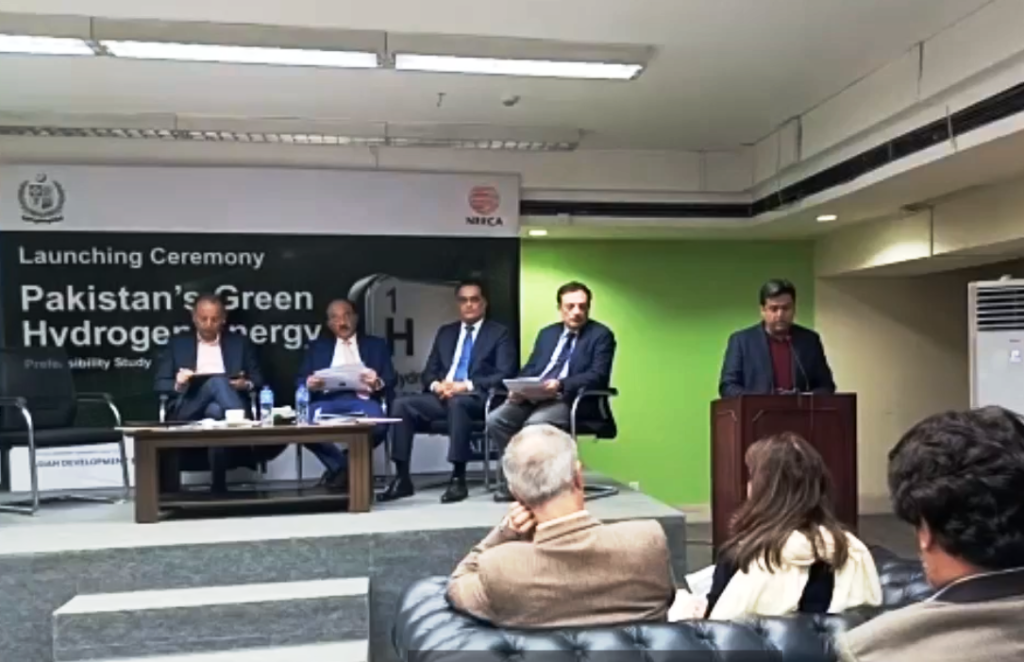
Islamabad : National Energy Efficiency and Conservation Authority (NEECA) launched Prefeasibility
Study on Pakistan Green Hydrogen Energy at NEECA office. Dr.
Sardar Mohazzam, Managing Director NEECA presented the background for conducting the
green hydrogen energy study in Pakistan. Mr. Stephen B. Harrison, International Expert on
Green Hydrogen and Dr. Nadeem Javed, Ex-chief economist presented key contours of the
prefeasibility study. Senator Dr. Musadik Malik, Mr. Masroor Ahmed, Chairman OGRA, Mr.
Yousuf Siddiqui, CEO Engro Energy Limited and Mr. Nadeem Javed Bajwa, MD ISGS also
expressed their expert opinion in the matter. Representatives from public & private sector and
Donor agencies also attended the launching ceremony.
The current power mix of Pakistan is primarily dominant with about 64% thermal mostly based
on imported fossil fuels including RLNG, Coal and RFO. Due to our reliance on imported fuel
and very high Energy prices at global level, it has become difficult for Pakistan to manage
reliable & cost-effective energy supply. This dependency on fossil fules also results in the
higher GHG emissions. The cost-effective solution to this problem is to harness the maximum
potential of indiginous Renewable Energy (RE) resources in the country as Pakistan has
abundant RE resources, including solar and wind power. Hydrogen due to its high energy
content, environmental compatibility, storage & distribution, and its ability to address
intermittency of RE sources, is an essential energy vector to ensure the reliable and cost-
effective harnessing of the RE resources of Pakistan.
The study identified and analyzed thirteen (13) value chain cases for financial modelling to
assess their economic viability under a range of current and hypothetical future scenarios and
determined three (03) most plausible value chains including (i). Hydrogen electrolysis from
hydroelectricity on the existing Ghazi-Barotha dam and admixing of the hydrogen at a low
concentration into the local natural gas grid; (ii). Using solar power from the Quaid e Azam
solar park to produce hydrogen on an electrolyzer for admixing at a low concentration into the
local natural gas grid for use on existing equipment heating, cooking and CNG applications to
incrementally decarbonize the gas pipeline network and CNG mobility; and (iii). One MW
Run of the river hydro power remote micro-grid with a portion of the power diverted for
hydrogen production during 10 months of hydro power generation. The hydrogen would be
stored and released to a fuel-cell for 2 winter months when the hydro plant would be winterized
to avoid ice damage.
The study highlighted that due to high capex cost for electrolyzer and related equipment and
higher electricity cost, at present the identified value chain projects are not financially feasible
and suggested some policy intervention to make them feasible including (i). Review of power
pricing tariff to enable the purchase of power for generation of hydrogen during periofds of
low demand, (ii) Very low or zero power cost for curtailed potential hydro power for hydrogen
generation, and (iii). Policy to attribute a cost to CO2 emissions (e.g., a tax on fossil fuel power
generation, a tax on transportation fuels or a tax on CO2 emissions). Since Green Hydrogen is
the fuel of future for clean and low carbon development, capex cost for generation of green
hydrogen will decrease gradually. Therefore, we should gear up to avail this upcoming
opportunity and shift to Green Hydrogen for decarbonization of our economy. Government is
addressing climate change challenges and shifting to clean fuel of Green Hydrogen subject to
the availability of international financing can be a catalyst.
The Launch of Pre-feasibility Study on the applicability of Green Hydrogen in Pakistan marks
a significant step towards a cleaner and more sustainable energy future. The findings of this
study can help to unlock the full potential of green hydrogen and will open up policy debates
for a roadmap to a low-carbon economy. NEECA pioneered the first of its kind Green
Hydrogen Study in Pakistan and will further work in this matter with collaboration of other key
stakeholders.