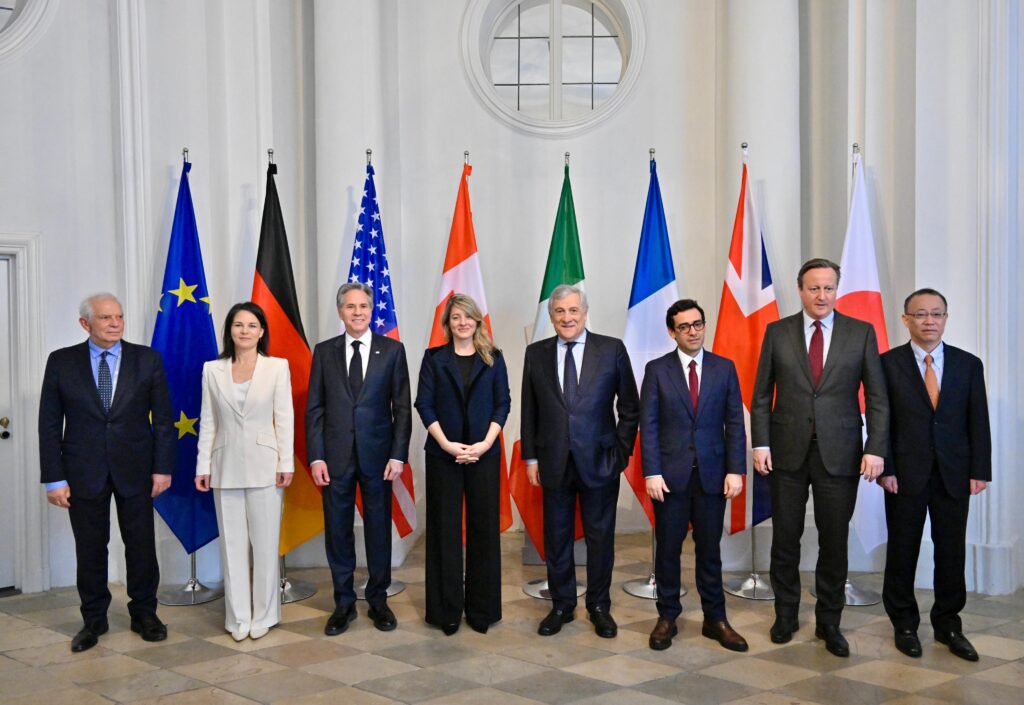
Statement by Antonio Tajani, Minister for Foreign Affairs and International Cooperation of Italy in his capacity as Chair of the G7 Foreign Ministers’ Meeting at the Munich Security Conference.
Munich : The G7 Foreign Ministers of Canada, France, Germany, Italy, Japan, the United Kingdom and the United States of America and the High Representative of the European Union reaffirmed their strong unity of purpose in their first meeting under the Italian Presidency in 2024.They renewed their commitment to upholding the rule of law, humanitarian principles, universal human rights and international law, including the UN Charter.They expressed their outrage at the death in detention of Alexei Navalny, unjustly sentenced for legitimate political activities and his fight against corruption. They demanded Russian Authorities to fully clarify the circumstances of his death. They called on Russia to stop its unacceptable persecution of political dissent, as well as systematic repression of freedom of expression and unduly limitation of civil rights.On the eve of the two-year mark of the brutal Russian aggression against Ukraine, they welcomed in their meeting Dmytro Kuleba, Minister of Foreign Affairs of Ukraine.They underscored that Russia’s war of aggression against Ukraine constitutes a blatant violation of the very tenets of the UN Charter. They reaffirmed their unwavering resolve to continue to support Ukraine in defending its freedom, sovereignty, independence and territorial integrity, within its internationally recognized borders and they commended Ukraine’s outstanding resistance and endurance. As acknowledged at the G7 Leaders meeting in Vilnius last year, the G7 members confirmed that -together with international partners- they are fast progressing with Ukraine on specific, bilateral, long-term security commitments and arrangements. They expressed their determination to continue to coordinate with partners to provide military, financial, political, humanitarian, economic and development support to Ukraine and its peopleas well as to strengthen sanctions against Russia and those who materially support its war. They also expressed their intention to step up efforts against evasion and circumvention of their sanctions and export control measures. They called on all countries to take active steps to prevent the acquisition of military equipment and dual-use items by Russia’s defense sector from or through their jurisdictions.They condemned Russia’s continued attacks on Ukrainian civilians and human rights violations. They reiterated their commitment to combat impunity by holding to account, consistent with international law, those responsible for crimes, which are of concern to the international community as a whole.They emphasized that Russia will have to pay for the damage and devastation it is causing to Ukraine and its people. They commended the work of G7 Finance and Foreign Ministries on this issue to date and supported their future discussions. They reaffirmed their determination to keep Russia’s sovereign assets in their jurisdictions immobilized until it pays for the damage it has caused. The G7 members will continue to explore all possible avenues to aid Ukraine in obtaining compensation from Russia, consistent with their respective legal systems and international law. They welcomed the adoption by the European Union of the legal acts concerning extraordinary revenues held by private entities stemming directly from Russia’s immobilized assets to support Ukraine.The G7 members confirmed that they will continue to address-together with international partners-Ukraine’s most urgent and long-term recovery needs and coordinate the support through the Multi-agency Donor Coordination Platform. They highlighted the importance of addressing the needs of the most vulnerable, especially women and children. They highlighted the upcoming Japan-Ukraine conference for Promotion of Economic Growth and Reconstruction, the 2024 Ukraine Recovery Conference to be hosted by Germany and the 2025 Ukraine Recovery Conference in Italy.They welcomed the European Council’s decision in December 2023 to open negotiations for Ukraine’s accession to the European Union. They underscored the significance of Ukraine continuing to implement reform efforts in line with the Euro-Atlantic path it has embraced.They strongly condemned North Korea’s arms transfers to Russia, which directly violate relevant United Nations Security Council resolutions. They also expressed their deep concern about the potential for any transfer of nuclear or ballistic missile-related technology to North Korea or any Russian transfers to North Korea of conventional weapons or other dual-use items in violation of the relevant UNSCRs, which would further threaten peace and stability across the world. They recognized that developments in the Indo- Pacific can directly affect Euro-Atlantic security.They called upon Iran to stop assisting the Russian military and its war of aggression against Ukraine. They also called for all countries to prevent the supply of components or other items to Iran’s UAV programmes, which are intended to support Russia’s war effort.They reiterated their support for Ukraine’s efforts – including through the “Peace Formula” process – to promote a comprehensive, just and lasting peace, in line with international law, in particular the UN Charter and through engagement with the widest array of global partners and actors.They condemned Russia’s irresponsible nuclear rhetoric, its posture of strategic intimidation, its announcement that it has deployed nuclear weapons in Belarus, at an increasingly unstable and dangerous moment, vand its undermining of arms control regimes.They reiterated that Russia’s seizure and continued control and militarization of the Zaporizhzhia Nuclear Power Plant is unacceptable and they reaffirmed their full support for the International Atomic Energy Agency’s efforts.Situation in the Middle East and in the Red SeaThe G7 members condemned in the strongest possible terms the terrorist attacks by Hamas and other terrorist groups against Israel that began on October 7, 2023. They called on Hamas to cease their on going attacks against Israel and emphasized Israel’s right to defend itself in accordance with international law. They urged Hamas to release all hostages without preconditions. They expressed their deep sadness for the heavy and unacceptable toll this conflict has taken on civilians.They called for urgent action to address the catastrophic humanitarian crisis in Gaza, particularly the plight of 1.5 million civilians sheltering in Rafah and they expressed deep concern for the potentially devastating consequences on the civilian population of Israel’s further full scale military operation in that area. They underscored that securing full, rapid, safe and unhindered humanitarian access in all its forms to the Gaza Strip remains an absolute priority and that all parties must allow unimpeded humanitarian support for civilians, including food, water, medical care, fuel, shelter, telecommunications, and access for humanitarian workers. They underlined the need to establish effective systems for the safety of aid convoys and humanitarian locations and to enable more UN staff, vehicles and eq